Malvertising is the biggest threat to user safety in mobile apps today, and most developers don’t know it’s happening until users are already gone. Auto-redirects yanking players out of sessions, deceptive UI elements tricking users into clicks they never intended, fake software update prompts, clickbait creatives designed to deceive: these aren’t edge cases. Malvertising campaigns are actively targeting mobile apps across every major category, operating through the same programmatic channels and ad networks that developers rely on for legitimate monetization.
The damage compounds quietly: churn rises, ratings drop, and lifetime value erodes while your ad stack looks clean. Traditional ad review won’t catch it, and by the time you realize it’s happening, it already has.
What Is Malvertising and Why Should App Developers Care?
Malvertising refers to the use of digital ads as a vehicle for threat actors to distribute malware, execute financial and criminal scams, and hijack user journeys at scale. While standard ad fraud degrades campaign performance, inflates metrics, and erodes advertiser trust, malvertising operates at a different level of severity entirely. It doesn’t just waste budget or skew data. It actively harms users, hijacking sessions, stealing sensitive data, installing malicious software, and manipulating them into ad-driven financial scams, all through ads that appear completely legitimate. The two threats often intersect, but malvertising is the one with direct consequences for your users and your app’s reputation.
What makes it particularly dangerous is the delivery mechanism. Malicious creatives enter your app through the same programmatic channels as every other ad, which means your users encounter them inside an experience they already trust. Unlike traditional malware that requires a user to download or install something, a malvertising attack can execute the moment an ad loads on a user’s mobile device and can even serve as the delivery vehicle for ransomware itself, with no interaction required.
For app developers and game studios, malvertising sits in a category of its own: invisible until it’s already running, operating through channels you trust, and leaving damage that compounds long after the campaign is gone. It is exceptionally difficult to detect in real time and nearly impossible to reproduce after the fact. By the time a developer attempts to investigate a user complaint, the malicious creative has rotated out, the cloaking has redirected the scan to a clean page, and the evidence is gone. There is no obvious entry point to close, no single bad actor to block, and no network policy that reliably stops it. That’s what makes it structural, and why it demands a different kind of response.
The 2026 Mobile Malvertising Threat Landscape
AppHarbr’s 2026 Ad Quality Network Index is the first independent ad quality and safety network performance ranking of its kind, built on analysis of 25 billion ads across 500+ apps and 45+ networks between November 2025 and January 2026. The findings establish the current baseline of malvertising risk across the mobile ecosystem with a level of specificity that self-reported network data cannot provide.
In gaming environments, 1 in 58 ads served is malicious. In non-gaming apps, the figure is 1 in 165. These are not outlier incidents. They represent the continuous baseline rate of ad malware delivery running across live user sessions right now. 50% of global ad networks analyzed failed to meet baseline ad safety standards, meaning that for any developer relying on demand partner promises as their primary malware detection, half of their supply chain is already compromised.
Platform exposure is not uniform. iOS users attract approximately 3x more malicious ads than Android users, driven by the higher CPMs that Apple’s premium audience commands. High-value users attract higher-value fraud. Developers monetizing iOS audiences are operating in the highest-risk segment of the ecosystem, often without knowing it.
The supply path itself is a differentiating factor in risk exposure. The Index found that header bidding SDKs consistently deliver cleaner supply than network SDKs, with significant performance variance across demand sources. For developers, supply path decisions are security decisions, not just yield decisions.
How Malvertising Enters Your App and Why It’s Almost Impossible to Stop
The programmatic ad ecosystem, spanning exchanges, networks, demand-side platforms, and real-time bidding, was built for scale and speed, not security. Developers and monetization teams have limited visibility into what actually renders inside their apps, and threat actors exploit exactly that gap. Malicious creatives are submitted looking clean, passing initial review because the harmful behavior simply isn’t there yet. But limited visibility is only part of the problem. Attackers deploy a layered set of evasion techniques, including environment detection, geo-targeting, delayed activation, and code obfuscation, specifically to appear clean the vast majority of the time, activating only against genuine targets in live sessions. The result is an attack that is highly targeted, rarely reproducible, and almost invisible to standard review processes.
The supply chain is the attack surface. Static creative scanning, manual review, and ad network promises are all built to evaluate what an ad looks like, not what it does in a live user session. By the time a malicious campaign is flagged and removed, it may have already run across thousands of real user sessions, completing its objective before anyone knew it was there.
What makes this structural problem so difficult to close is the sophistication of the evasion layer threat actors deploy. Malicious creatives are not just submitted and served; they are engineered specifically to survive review, defeat scanning tools, and activate only when conditions favor a successful attack. In most campaigns, threat actors begin with a deliberate warm-up stage: submitting entirely legitimate creatives and landing pages to build trust with ad networks and DSPs, gaining approval and rotation before switching to malicious payloads. By the time the malvertising attack activates, the campaign already has established credibility in the supply chain.
Cloaking is the foundational evasion technique. The ad serves a clean, harmless version to scanners, reviewers, and quality assurance environments, while delivering the malicious payload exclusively to real users in live sessions. The creative that gets approved and the creative your users see are not the same.
Code obfuscation scrambles the underlying malicious code so that automated detection tools, or human analysts, cannot read, parse, or flag it. Even when security systems scan the creative, the harmful instructions are encoded in ways that defeat pattern recognition and signature-based analysis, which is why novel malware variants that haven’t been seen before are so effective against static defenses.
User fingerprinting allows the malicious creative to detect its environment before activating. If the ad determines it’s being viewed in a sandboxed scanning environment rather than on a real mobile phone, it behaves cleanly. The attack only triggers when fingerprinting confirms a genuine target, making sandbox-based detection largely ineffective against sophisticated campaigns.
Delayed activation is a technique most commonly associated with auto-redirects, where the redirect does not fire immediately on ad load but triggers after a few seconds, or only when the user touches or scrolls the screen, making it significantly harder to connect the redirect to the ad that caused it. Beyond timing, many threat actors operate in short bursts of a few hours at a time, rotating domains continuously to clear their traces and evade detection. By the time a campaign is identified and investigated, the domains have changed, the creative has rotated out, and the attack has already moved on.

Geo-targeting and device-specific triggers restrict the attack to specific regions, operating systems, or user segments. A malvertising campaign targeting users in one geography will appear completely clean to quality teams reviewing from another location, creating systematic blind spots in any review process that isn’t conducted from within the target environment.
Beyond evasion techniques, the mechanics of how users enter the scam funnel follow two primary paths. The first is code-based: auto-redirect scripts fire when the ad loads, or after a delay triggered by a screen touch or scroll, pushing users directly to the scammer’s landing page without any voluntary action. The second is social engineering: deceptive creatives use urgency, fake alerts, misleading CTAs, or fabricated rewards to lure users into clicking and taking themselves to the scam page. In both cases, drive-by malware installation is the exception rather than the rule. Most malvertising attacks require the user to play an active role in the scam, which is precisely why the creative layer is engineered so carefully to manufacture that action.
Taken together, these techniques represent a deliberate, professional threat infrastructure. This is not opportunistic abuse of the ad system. It is organized, financially motivated cybercrime, engineered to exploit vulnerabilities in the defenses that most mobile publishers currently rely on.
The Malvertising Attack Taxonomy: Every Threat Your Users Face
Malvertising arrives in dozens of variants. The following attack types have proven consistently effective at defrauding mobile users and appear most frequently across the ecosystem today.
Auto-redirects are the most prevalent delivery mechanism in mobile malvertising. Cybercriminals embed redirect scripts in ad creatives that fire when the ad loads, or after a delay triggered by a screen interaction, pushing users out of the app and onto scammer-controlled landing pages without any voluntary action. The redirect itself is not the attack. It is the entry point to it. What users encounter on the other side ranges from fake e-commerce stores and investment scams to gift card fraud and fake software update prompts, all engineered to extract payment, credentials, or personal data from users who have no reason to distrust the environment they were just delivered to.
Fake antivirus warnings and fake software update prompts are primarily spyware delivery mechanisms. Users are told their phone is infected or out of date and directed to download what appears to be a security or system tool. The downloaded application installs malware that harvests sensitive data from the device, which is then sold on the dark web. Tech support scams might look similar but operate differently: users are presented with a fake critical system error and prompted to call a support hotline. On the call, they are told their data is at risk and pressured into paying a ransom to resolve a problem that doesn’t exist. Deceptive ads serve as the creative layer across both of these attack types, using urgency, OS interface mimicry, misleading CTAs, and fabricated system alerts to manufacture the panic that makes users act without verifying.
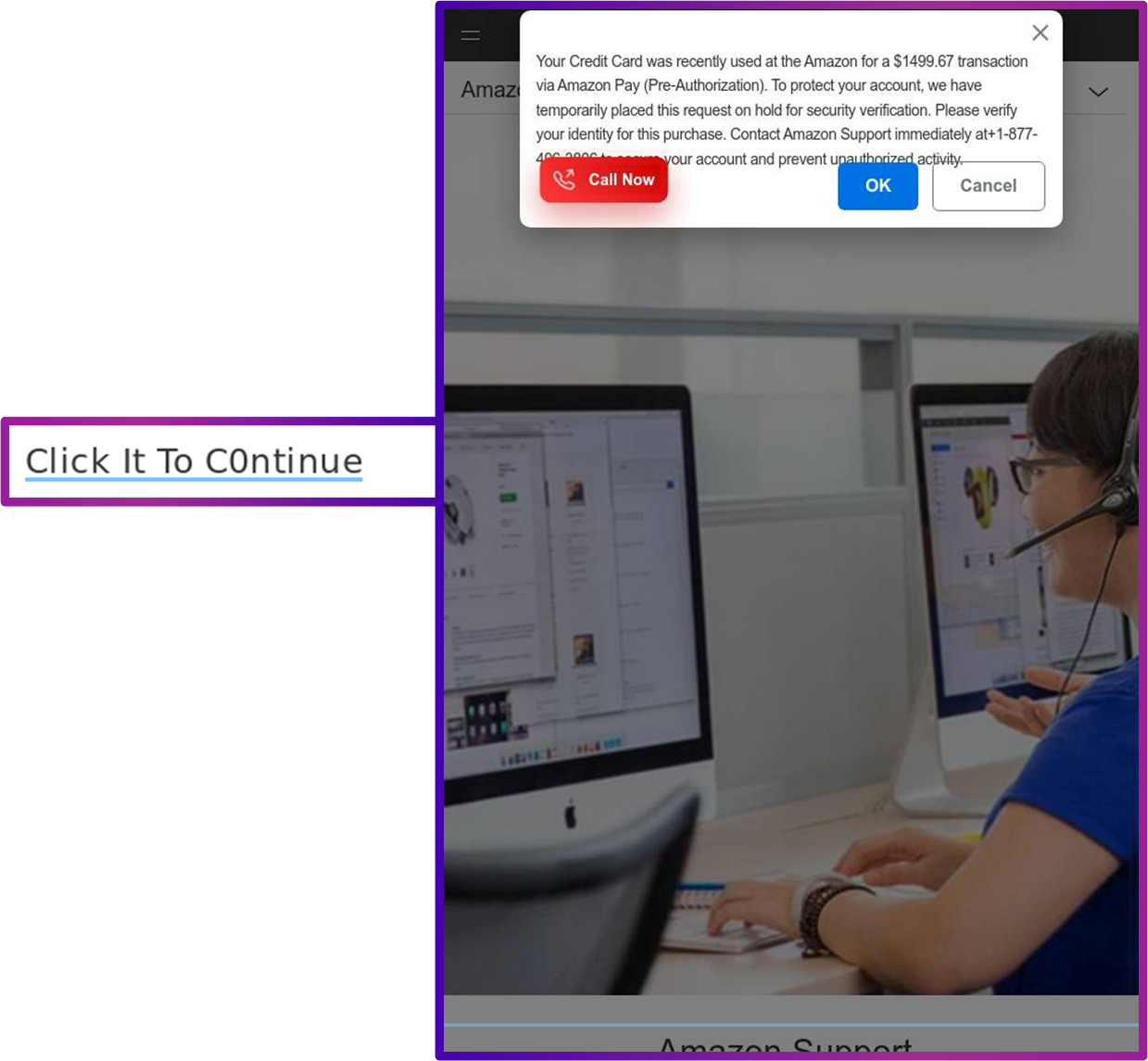
Brand impersonation creatives mimic the visual identity of household names, a grocery chain, a bank, a telecom provider, to harvest credentials or payment data on spoofed landing pages. Misleading product offers extend this further: cybercriminals first run clean campaigns to build network trust before switching to deceptive creatives, serving clickbait ads that lead to fake editorial landing pages complete with fabricated articles, fake reviews, and countdown timers. Cloaking cherry-picks targets by device, location, and connection type, hiding the attack from everyone else. Users who convert risk financial loss and full data compromise.
Suspicious VPN ads promote free streaming or gated content, prompting users to install an application that functions as advertised but carries covert components harvesting credentials, intercepting internet traffic, and exposing mobiles to spyware or unauthorized cryptocurrency mining.
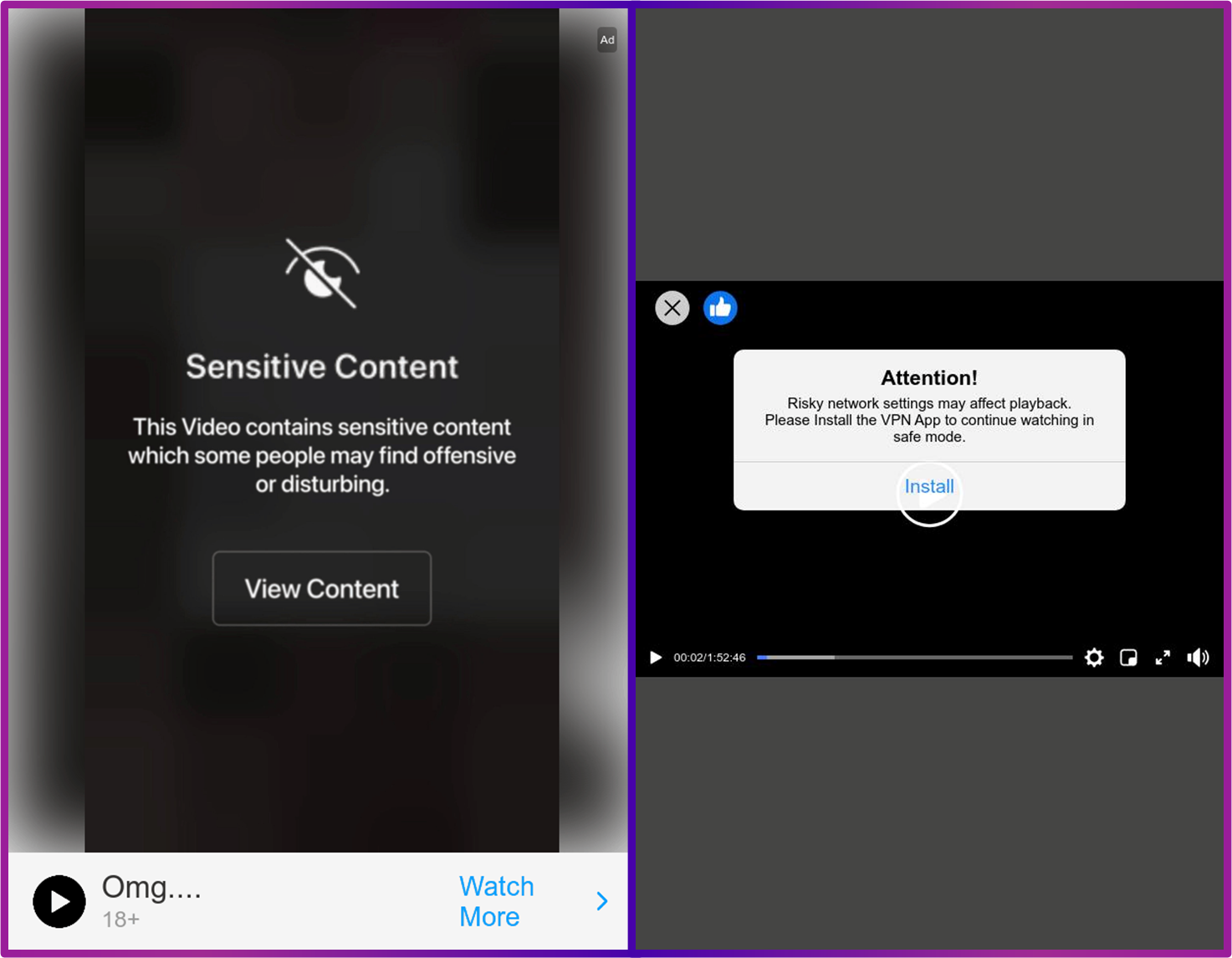
Some attacks embed malicious code directly in the ad creative itself, before any landing page is involved. Pre-click malicious ads can carry cloaked behavior within the creative, execute auto-redirects without user interaction, or attempt to generate fraudulent impressions and clicks. The malicious code activates at the ad level, making these attacks harder to trace and easier to disguise as legitimate ad activity. Drive-by downloads, where exploit kits on redirected landing pages silently install malware on the user’s device, were more prevalent in browser-based environments and have declined significantly since 2020, though the redirect-to-malicious-page mechanic they relied on remains active in other attack forms covered above.
Who Gets Targeted: Malvertising Risk by App Category
Threat actors don’t target apps randomly. They target categories with the highest combination of ad volume, session density, and security investment gaps. Hyper-casual and casual games represent the highest-volume ad environment in mobile: short sessions, high frequency, broad demographic reach, and historically lower investment in ad quality infrastructure make them the most systematically targeted category in the ecosystem.
News and social apps attract financial scams and brand impersonation campaigns specifically because the editorial trust users extend to these environments makes deceptive creatives more effective.
Children’s apps represent the highest compliance risk category. A single malvertising incident involving a scam ad, data-harvesting creative, or inappropriate redirect creates simultaneous exposure to COPPA, GDPR-K, and App Store and Google Play advertising policies, with potential consequences ranging from regulatory scrutiny to store delisting.
Lifestyle, utility, and community apps are increasingly targeted as cybercriminals follow inventory into less-scrutinized environments. High fill rate requirements in these categories create consistent pressure to accept demand from lower-quality networks, widening the attack surface as larger publishers invest in protection elsewhere.
What Malvertising Is Actually Costing You
When malvertising enters your app, the damage doesn’t arrive all at once. It accumulates. Users pushed to scammer-controlled landing pages are less likely to return to your app, less likely to convert, and more likely to leave a review that warns others away. The immediate cost is lost monetization from sessions that end prematurely. The long-term cost is the erosion of return rates, ARPU, and lifetime value as users associate your app with an experience they no longer trust.
Negative reviews are often the first visible symptom. Ratings drop as frustrated users describe disruptive ads, fake warnings, or being pushed to a malicious site mid-session. A sustained drop in store rating doesn’t just reflect user sentiment. It directly reduces organic visibility, weakens payer conversion, and raises UA costs at exactly the moment you can least afford it. AppHarbr’s 2026 Ad Quality Network Index found that 84% of players uninstall games due to negative ad experiences, and 61% actively discourage others from playing games with poor ad experiences. One malicious advertising campaign can trigger both.
The compliance risk is separate and potentially more severe. Malvertising can push your app into violation of App Store or Google Play ad guidelines, triggering de-ranking, rejection of updates, or suspension of your listing entirely. These aren’t theoretical outcomes. They’re the downstream consequence of a security issue that most developers don’t discover until it’s already in motion.
By the time malvertising shows up in your dashboards, it has already been running. The sessions are lost, the reviews are posted, and the store flags are filed. That’s the nature of the threat, and why waiting to react is not a viable strategy.
What Actual Protection Looks Like: SDK-Level Detection and Blocking
App developers and studios can’t control the entire ad supply chain, but they can control what executes inside their app. This is the core principle behind malvertising protection SDK technology: instead of relying on static creative scans, manual QA, or ad network guarantees, the protection layer lives inside the app itself, monitoring ad behavior in real time at the moment of serving.
This goes beyond signature-based blocklists and policy filters. An SDK-level solution evaluates ad code and content before the creative is served, intercepting auto-redirects, blocking ads that would launch phishing pages or fake alerts, and stopping malicious impressions before they ever reach the user. A dual-layer approach combines a robust blocklist with an anti-cloaking engine that identifies malicious creatives even when they are presenting clean behavior to scanners, catching attacks that signature-based tools and mediation filters consistently miss, without generating false positives that pull clean ads from your inventory. When a malicious creative is blocked, it is automatically replaced with a clean ad, preserving the impression and the revenue, while the system reports the violation to your team and to the originating network, closing the loop without manual intervention.
Most ad quality controls available through mediation providers operate reactively: they can flag violations after the fact or give developers the option to manually report to demand partners, but they are not built to block malvertising and do not specialize in security. SDK-level protection closes that gap surgically, targeting malicious behavior specifically without disrupting clean inventory. The creative may have passed every upstream check. It doesn’t matter. If it’s flagged as malicious before it renders inside your app, it never does, and your users never know anything was wrong.
This is the last-mile defense that attackers have exploited the absence of for years. Integration requires no change to your monetization workflow and is invisible to users, but it’s the only protection layer that operates where the threat actually materializes. AppHarbr’s real-time detection and threat intelligence closes that gap in milliseconds, across every impression, every session, every network in your stack.
How to Choose the Right Malvertising Protection Solution
For most app developers and game studios, the baseline for comparison is not a dedicated security solution. It is the ad quality tools bundled with their mediation platform, and these tools are not designed to detect malvertising. At best, some claim to identify redirects. None of them block ads. Their standard response to a malicious creative is a manual report to the demand partner, submitted one incident at a time, after the damage has already been done.
Evaluating purpose-built malvertising protection against that baseline requires a different set of criteria. The gap is not just technical, it is a question of specialization, independence, and proven deployment at scale. Beyond those foundational differences, these are the criteria that separate genuine protection from surface-level compliance.
Pre-impression blocking, not post-serve detection. In mobile environments, most malvertising attacks trigger without any user interaction: malicious code executes the moment the creative loads, before a tap, before a click, before the user is even aware an ad appeared. Protection that operates after serving has already failed. An effective solution must block both pre-click and post-click attack vectors at the pre-impression level, before the creative ever renders. Any solution that cannot do this is not a malvertising protection SDK.
Anti-cloaking detection, not just signature matching. Signature-based detection fails against obfuscated code, delayed payload attacks, and creatives engineered to behave differently in scanning environments than in live sessions. The only way to catch cloaked attacks is an engine built specifically to identify them despite their evasion efforts, one that can recognize when a creative is presenting a clean face to reviewers while delivering a malicious payload to real users. This is a specialized capability that general ad quality tools and mediation platforms do not have.
Ad replacement, not just removal. Blocking a malicious ad should not mean losing the impression. Solutions that replace blocked creatives automatically with clean ads preserve monetization revenue while maintaining protection. Solutions that simply remove blocked ads create revenue gaps that make adoption economically painful.
Demand-agnostic enforcement. Protection that only applies to certain networks or demand sources leaves gaps that cybercriminals will find and exploit. Effective protection must operate across every demand source in your stack, regardless of network or mediation partner.
Violation reporting and partner accountability. Protection without visibility is incomplete. The solution should automatically report blocked creatives to your team and to the originating network, creating an accountability loop that improves supply chain quality over time.
Lightweight integration with no monetization disruption. An SDK that adds latency, disrupts mediation waterfalls, or requires significant engineering resources to integrate will face internal resistance and incomplete deployment. Protection that integrates invisibly and operates without workflow changes is the only kind that gets fully adopted.
Security-first, with no conflicting interests. A purpose-built malvertising solution has no conflicting interests with the demand partners it is monitoring. It is built specifically to detect and block malvertising, not as a secondary feature of a monetization platform. And it operates across all networks and mediation options without requiring a change to existing infrastructure.
AppHarbr is built to satisfy all criteria. It operates at the pre-impression level, deploys a purpose-built anti-cloaking engine backed by GeoEdge’s 10+ year threat intelligence dataset, replaces blocked ads automatically, covers all demand sources, reports violations in real time, and integrates as a lightweight SDK with no changes required to your existing monetization setup.
Implementation Checklist and Next Steps
The fastest path to protection starts with understanding where you’re currently exposed. Before integrating any solution, audit your demand sources. List every ad network, exchange, and mediation partner serving ads in your app, and identify where each partner ranks in terms of malvertising violations. Then check your support logs and store reviews for historical complaints about redirects, fake alerts, or suspicious ads. These are the fingerprints of malvertising campaigns that have already run.
From there, the evaluation question is simple: do your current tools detect threats after an ad is served, or before? If the answer is after, or you’re not sure, you have a gap that network-level filtering won’t close. Customers who have integrated AppHarbr consistently identify malicious campaigns that their existing ad stack never surfaced.
AppHarbr integrates as a lightweight SDK directly into your app, requiring no changes to your monetization workflow or mediation setup. It blocks malicious creatives at the pre-impression level, replaces them automatically with clean ads, and reports violations to your team and your demand partners in real time. Setup is fast, the integration process is straightforward, and for game studios running high ad volume across multiple networks, Voodoo achieved a 5% ARPU boost and 50% improvement in ad quality monitoring efficiency after integrating AppHarbr.
Malvertising Won’t Wait. Neither Should You.
Malvertising is already in your ad stack. It’s running right now, through the same trusted channels as every legitimate ad you serve, and your current review processes almost certainly won’t catch it before your users do. The only protection that works is the kind that operates where the threat materializes: inside your app, before the ad renders.
AppHarbr is built for exactly that. Request a demo today and find out what’s already running in your inventory.