A game studio notices a dip in Day 7 retention and can’t find the cause: UA looks fine, onboarding hasn’t changed, the core loop is intact. Then a user review surfaces: “Adverts goes on like 2-3mins after each level!!! uninstalling.” It’s not an isolated complaint: across gaming and non-gaming apps alike, disruptive and malicious ads are quietly eroding the metrics that monetization teams work hardest to protect. A news app collects one-star reviews it can’t explain. A utility app watches uninstall rates climb with no clear product trigger. In each case, the problem isn’t the product. The advertisements are.
This pattern is more widespread than most publishers account for. Network and mediation filters weren’t built to solve this problem. Their business model is built on maximizing ad delivery, not on blocking it, which means the incentive to filter aggressively simply isn’t there. What gets through reaches real users in real sessions, affecting retention, reviews, and revenue before anyone on the team has identified the source. That makes ad quality less of a compliance concern and more of a direct input into retention, store ratings, and sustainable yield.
What Is Ad Quality in Mobile Apps?
Ad quality in mobile apps covers what advertisements do, not just what they look like. A creative that promotes graphic violence, auto-redirects users without consent, or locks them into an unskippable video all represent failures: of content, user safety, and user experience respectively. All of it falls under the ad quality umbrella, alongside broader content compliance and network-level enforcement.
For publishers, this matters because bad ads don’t stay contained. They surface in retention curves, app store reviews, and platform enforcement actions. Managing ad quality means monitoring in-app advertising across every demand partner, configuring enforcement rules that cover content, security, and user experience, and treating network performance data as an operational input, not a quarterly report.
Ad quality is not a moderation task. It is a core part of any effective in-app advertising strategy, and most publishers are not treating it like one.
The Real Cost of Bad Ads: Revenue, Retention, and Store Ratings
Bad advertisements hit the metrics that matter most to publishers from multiple directions at once: ARPU, churn rate, store rankings, and user acquisition efficiency, often simultaneously, and rarely visible until the damage is already done.
According to AppHarbr’s Ad Quality Network Index, 1 in 58 advertisements served in gaming environments is malicious, and 1 in 165 in non-gaming apps. Offensive or sensitive content appears in 1 in 182 gaming ads and 1 in 170 in non-gaming. On the user experience side, every 5th interstitial and every 10th rewarded ad served in gaming is unskippable. These are not edge cases. They are persistent conditions in live traffic, present across verticals, formats, and geographies.
The user impact is direct. Players and app users do not distinguish between the app and the ad. A misleading offer, a scam landing page, or a video ad with no functional close button gets attributed to the app itself. AppHarbr’s research found that 84% of players uninstall games due to negative ad experiences, and 61% actively discourage others from playing games where they encountered poor ad quality. The damage extends beyond the individual session. Existing users uninstall; potential new ones see the reviews they left behind.
Store ratings compound the problem. A cluster of bad ad incidents drives a review spike, and even minor star drops reduce app store optimization performance, suppressing organic visibility, reducing install volume, and increasing the cost per install of paid user acquisition campaigns to compensate.
Platform enforcement adds another layer. Repeated policy violations, whether through advertisements that violate content standards or creatives that reach the wrong audience through imprecise targeting, can trigger ad serving restrictions or cause app store listing removal. For apps in regulated categories, the exposure is higher.
Publishers who stay on top of ad quality protect their monetization. The question is how. For most teams, the answer starts with recognizing the limits of their current approach.
Automated vs. Manual Ad Quality Management in Mobile Apps
Ad quality management in most mobile apps starts the same way: an ad ops manager monitors notifications from their mediation partner and manually reaches out to networks when a problematic ad surfaces. That means sending an email and waiting for a response, all while the bad ad continues serving to real users throughout the entire escalation process. If the network responds and blocks it at all, the same ad is likely already serving from a different network the next day
Standard mediation platforms offer limited visibility, primarily flagging certain content category violations in their UI, and even that coverage applies mainly to full-screen formats. They don’t actively block anything. When a flag surfaces, it falls to the ad ops manager to report it to the network and request removal, restarting the same manual escalation cycle. Malvertising and user experience violations such as auto-redirects, deceptive download prompts, and interstitials that exceed your defined time limits don’t get flagged at all. These creatives appear compliant on the surface while the real damage happens at the impression level, in real user sessions, with no automatic intervention.
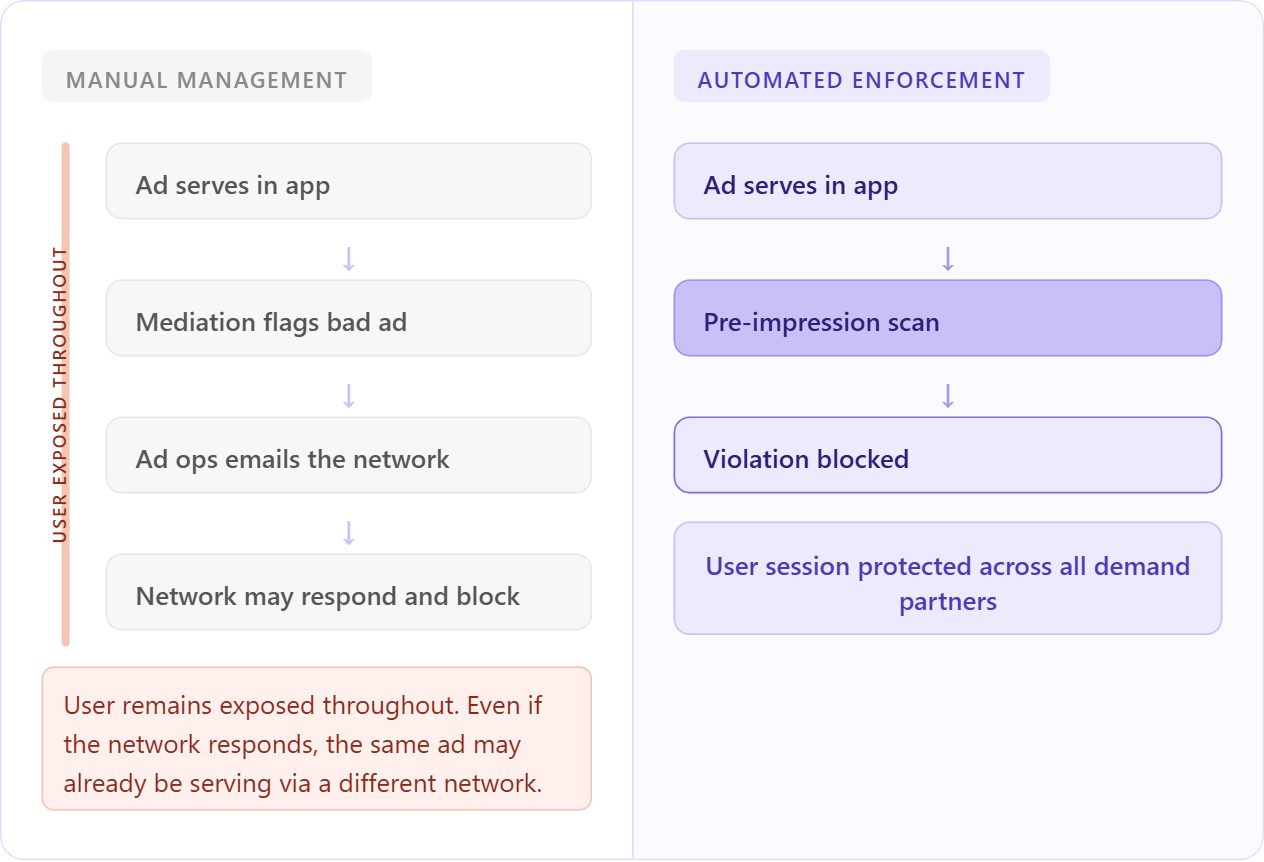
Automated ad quality platforms take a fundamentally different approach: proactive enforcement rather than reactive flagging. Instead of waiting for mediation notifications or user complaints, they block policy-violating advertisements before they reach users, across 100% of live traffic and every demand partner simultaneously. That has an immediate business impact: fewer complaints, protected ARPU, and lower risk of store rating drops, while also freeing ad ops teams from the manual escalation cycle that consumes their time without solving the underlying problem. The visibility layer comes on top of that: granular reporting on which networks generate the most violations, which categories drive complaints, and how enforcement decisions affect fill rate and yield. Publishers can also test enforcement rules in monitoring mode before applying them at scale, reducing the risk of over-blocking and giving teams the flexibility to adjust policies as the ad environment evolves.
For publishers managing multiple demand partners across complex waterfalls or in-app bidding setups, automation is not a convenience. It is the only approach that scales. The sheer volume and velocity of programmatic app advertising make comprehensive manual review operationally impossible at any meaningful level of traffic.
Mobile Ad Quality Best Practices by App Vertical: Hyper-Casual, Game Studios, and Non-Gaming Apps
Ad quality risks vary significantly by vertical, and so do the enforcement priorities. The violations that matter most differ depending on how each app monetizes and how long it expects to keep a user.
Hyper-Casual Games
Hyper-casual games operate on a high-volume, low-LTV model. Players churn fast, and monetization depends on serving as many ad impressions as possible before they do. The primary metric is ARPDAU (average revenue per daily active user) and the fastest way to protect it is reducing ad length. Shorter time limits on rewarded video and interstitials increase the number of ads a user can see within a session, which directly drives impression volume and yield. The second priority is blocking security violations, particularly on banners, where malicious ad rates are highest. Auto-redirects, scam creatives, and deceptive ads designed to mimic app UI elements or buttons trick users into clicking and redirect them out of the session involuntarily. Every session cut short by a bad ad is revenue that can’t be recovered.
Casual and Mid-Core Games
Casual and mid-core games operate on a longer retention curve and a different revenue model. In-app purchases are typically the primary income source, with in-app advertising as a secondary revenue stream. That distinction changes the calculus around ad quality significantly. A malicious ad or an auto-redirect doesn’t just end a session, it accelerates churn, shortening the window the app has to convert a user to IAP. Security violations are the top enforcement priority here for exactly that reason. Inappropriate content such as offensive creatives, sexually explicit ads, ads promoting drugs or gambling carry similar risk, particularly for family-friendly titles, older user bases, or apps targeting conservative markets. Time limits on rewarded video and interstitials remain important for ARPDAU, but sit behind security and content enforcement in priority. One additional control that matters in this segment is competitor blocking: ads from similar games running inside your app actively encourage users to leave for a competitor, compounding the churn risk that bad ads already create.
Non-Gaming Apps
Non-gaming apps like news, utility, lifestyle and community platforms share the retention-first logic of casual and mid-core games, but with a different format mix. Banners and native ads are the dominant formats here; rewarded video and interstitials appear less frequently, though when they do, time limits still matter for the same ARPDAU reasons. Security violations are the primary enforcement concern. Auto-redirects and scam ads don’t just interrupt a session; they erode the trust that habitual-use apps depend on. A user who encounters a scam in their news app or a deceptive ad in their utility app doesn’t distinguish between the ad and the product. They find a safer alternative, and they don’t come back. Inappropriate content carries the same risk it does in family-friendly games, with the added sensitivity that non-gaming apps frequently serve broader demographics including older users and regulated markets. Competitor blocking is also relevant here: a utility or lifestyle app serving ads for a direct competitor is actively funding its own churn.
Format-Specific Ad Quality Optimization: Rewarded Video, Interstitials, and Beyond
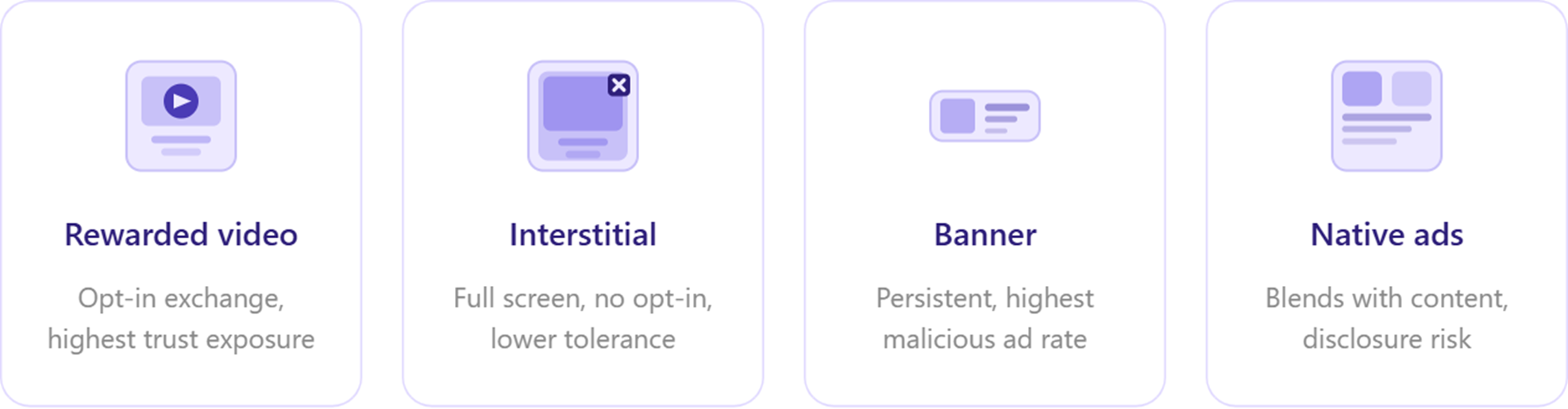
Ad formats determine which violations are most likely to surface, not which violations are possible. The same security, content, and UX threats exist across all formats, but their frequency and business impact vary depending on how each format is experienced by the user.
Rewarded Video
Rewarded video is opt-in: the player agrees to watch in exchange for a reward. Any break in that exchange, whether a missing close button, an ad running past its time limit, or a reward that doesn’t deliver, is experienced as a personal violation. Both rewarded video and interstitials require enforced time limits and functional close buttons across every demand partner, but the stakes of getting it wrong are higher with rewarded video precisely because opt-in.
Interstitials
Interstitials carry no user opt-in. The ad interrupts the session, tolerance for friction is lower from the start, and a trapped or extended interstitial reads as manipulative rather than just inconvenient. Auto-playing sound compounds the disruption significantly: an interstitial that fires unexpectedly with full audio is one of the most jarring ad experiences a user can encounter, and one of the fastest routes to an uninstall. Load time matters too: a slow or failed ad load creates a frozen screen that ends the session before the ad has even served. Enforced time limits, functional close buttons, muted-by-default audio, and placement-level frequency controls are the baseline enforcement requirements across all demand partners.
Banners
Banners carry a different risk profile than their low-engagement reputation suggests. While UX violations are less immediately disruptive, banners are where malicious ad rates are highest across formats. Auto-redirects and scam creatives that pull a user out of the app are more prevalent in banner inventory than in rewarded or interstitial placements. Banner positioning also matters: poor placement leads to accidental clicks that send users out of the app unintentionally, hurting both UX and session metrics. Unexpected banner behavior: ads that expand, flash, play unsolicited audio or in-banner video should be blocked as a baseline enforcement standard.
Native Ads
Native ads present a different set of concerns. The format is designed to blend with surrounding content, which creates a disclosure risk that other formats don’t carry. When the line between editorial and paid content is unclear, users feel misled and trust erodes. Industry standards and most regional regulatory frameworks require that paid content be clearly identified as such, and advertisements that blur this distinction are a common source of policy violations. Content compliance is the primary enforcement priority here: native ads that promote inappropriate, offensive, or misleading content undermine the credibility of the app environment they appear in.
Measuring Ad Quality in Mobile Apps: Metrics, Reporting Dashboards, and ROI
Fill rate and eCPM are essential: they tell you how much demand you’re capturing and at what value. Ad quality metrics add a second layer of visibility that those numbers alone can’t provide, specifically what is actually happening at the impression level. A network can deliver strong eCPM while also generating a disproportionate share of malicious or non-compliant advertisements. Without that additional layer, there is no way to know whether that eCPM is coming at the cost of user retention, store ratings, or long-term ARPU.
Closing that gap requires the right reporting infrastructure. A dashboard built for ad quality gives publishers visibility at the creative and placement level, not just the network level: which demand partners generate the most violations, which ad categories drive complaints, and how enforcement decisions connect to downstream business metrics. These are the key metrics that turn ad quality from a moderation concern into a revenue performance indicator. Aggregated network reports and mediation dashboards don’t provide this. And without real-time data, demand partners generating repeat violations can’t be escalated before the damage compounds. Problems stay hidden until they surface in reviews or declining LTV.
That visibility is what makes the ROI case measurable. Publishers who can draw a direct line between an enforcement change and a business outcome: a drop in negative reviews following a blocklist update, a retention lift after skippability rules are applied across a specific network, reduced uninstall rates after a category exclusion is enforced, stop treating ad quality as a cost and start managing it as a revenue variable with a trackable return. Testing different enforcement configurations and measuring the downstream impact is how leading teams optimize their approach over time.
Mobile Ad Quality Optimization Checklist: Maximize Revenue Without Hurting User Experience
Ad quality optimization is not a project with a finish line. It is an operational discipline that compounds over time. Each enforcement improvement, network escalation, or format-specific rule tightened contributes to a marketing and monetization strategy where advertisements deliver sustainable revenue rather than persistent risk. The publishers who reach this level don’t do it by reacting to every new problem; they build the processes, measurement infrastructure, and enforcement controls needed to optimize ad quality before users ever notice an issue.
Here is where that process starts.
- Map Ad Quality Risks by App Vertical: Analyze how your risk profile and performance changes across hyper-casual, mid-core, and non-gaming apps. Tailor enforcement and content standards to each segment’s target audience, user expectations, and monetization model.
- Enable Format-Specific Enforcement: Apply differentiated rules across diverse ad formats: rewarded video, interstitials, banners, and native ads. Set non-negotiable standards for seamless user experience across all demand partners.
- Automate Ad Quality Monitoring: Move from manual back-and-forth with ad networks to proactive filtering and blocking at the impression level. Automated enforcement stops bad ads before they reach users: no escalation emails, no waiting on network responses, no gaps between discovery and action.
- Establish Real-Time Reporting Dashboards: Track the incidence of malicious advertisements, complaint frequency, and which demand partners are responsible for the most violations. Escalate issues proactively before the business impact compounds.
- Tie Ad Quality Metrics to Business Outcomes: Test enforcement configurations and monitor the correlation between ad quality incidents and changes in ARPU, user retention, uninstall rates, and store ratings. Adjust based on granular, placement-level data, not quarterly aggregates.
- Treat Enforcement as a Continuous Process: Update blocklists, category exclusions, and format rules routinely, responding to evolving threats, network performance, and shifting business goals. Ad quality management has no end state.
Publishers who embed this process systematically stop absorbing the hidden costs of bad advertisements and start managing in-app advertising quality as a measurable revenue variable. The difference is reflected in stronger retention curves, higher store ratings, and improved LTV. Not just fewer user complaints.
Bad ads are reaching your users right now. AppHarbr gives you the real-time enforcement, format-specific controls, and placement-level visibility to stop them before they affect your retention, ratings, or revenue. Request a demo to see it in action.