Online gambling promotions don’t always look like online gambling promotions. A free-to-play social casino game promoted as a ‘puzzle game,’ fantasy sports sweepstakes filed under ‘entertainment,’ a poker or roulette app creative that clears every category filter in your mediation stack and lands in a children’s trivia app anyway. All predictable consequences of how gambling ad classification actually works across programmatic supply chains.
For mobile app publishers, the stakes are higher than most anticipate. A misclassified creative can breach a lucrative exclusive sponsorship agreement, trigger app store enforcement, or put a family-friendly app on the wrong side of regional online gambling advertising laws. Standard mediation and network-level blocks weren’t built to catch this, and the programmatic ecosystem has no particular incentive to fix it.
This is what real-time filtering for online gambling creatives exists to solve: not blanket prohibition, but publisher-controlled precision over which betting and gaming creatives appear in your app, under what conditions, and for which users.
Why Online Gambling Ads Bypass Your Category Filters (The Misclassification Problem)
Standard ad category filters were never designed for the realities of today’s online gambling advertising, a fact that’s increasingly costly for publishers. According to AppHarbr’s In-App Network Ad Quality Index (Nov 2025–Jan 2026), 1 in 33 ads served in gaming apps is related to gambling apps or betting, and in non-gaming apps, that figure rises to 1 in 18. Trusting advertisers to classify their own campaigns correctly is like trusting a cat to guard a bowl of milk.
Advertisers promoting prizes, casino games, lotteries, poker, slot machines, and other forms of gambling, whether intentionally or inadvertently, often categorize campaigns under less-restricted verticals such as “gaming,” “entertainment,” or “sports” to maximize reach. Some creatives blur the lines with free-play social casino games, fantasy sports sweepstakes, or skill-based gaming experiences that skirt the official definitions of gambling games in policy documents. As a result, promotions for lotteries, casino games, and gambling apps frequently escape basic categorization filters and appear in environments the publisher never intended, sometimes even within children’s apps or family gaming titles.
Blocking online gambling content with one demand partner offers no guarantee that the same creative won’t clear filters elsewhere in your stack. AppHarbr’s data confirms this isn’t a fringe issue: policy-violating creatives regularly bypass both network and mediation safeguards, reaching users in live app sessions. These misclassified or disguised online gambling promotions present a systemic risk, one that demands active, adaptable controls at the creative level. For publishers, the consequences run deeper than a single inappropriate creative: the business risks, from regulatory exposure to breached sponsorships, are far greater than most expect.
The Business Risks of Online Gambling Advertising for Mobile App Publishers
For apps where gambling ads have no place, whether by audience, content rating, or contractual obligation, the risks run far deeper than user complaints. When a gambling creative slips through category filters and appears in the wrong context, publishers face exposure on multiple fronts.
The nature of that exposure depends on who you are as a publisher. For some, the central threat is regulatory: gambling ad compliance for app developers is governed by a constantly evolving patchwork of laws, age restrictions, and content policies across jurisdictions. Platforms like Google Play and the App Store increasingly hold publishers, not networks, accountable for violations that originate with third-party mediation chains or misclassified campaigns. For others, the risk is contractual: a competitor’s betting creative appearing in inventory covered by an exclusive sponsorship deal can jeopardize the entire arrangement, trigger eCPM dilution through programmatic bleed, and in some cases lead to litigation. For family and kids’ app publishers, it’s an audience risk: one misclassified social casino game or fantasy sports betting ad can incite parental backlash, negative press, and app store scrutiny that damages star ratings, diminishes LTV, and undermines user acquisition efficiency.
What these scenarios share is a common root: a creative that cleared the wrong filter, in the wrong context, with consequences that static category blocking was never designed to prevent.
Preventing Competing Betting Ads: Protecting Exclusive Sponsorship Deals
A rival gambling app’s creative clears your mediation filters and serves in inventory contractually reserved for an exclusive sponsor. The sponsor notices. Now you’re fielding a call from their legal team.
Standard category blocking depends on accurate categorization, and as the previous section established, online gambling advertisers have every incentive to misclassify. A competing gambling app’s campaign filed under “sports,” “entertainment,” or “gaming” won’t be caught by an exclusion filter for online gambling, regardless of how carefully it’s configured. The misclassification problem doesn’t just affect family apps and compliance teams: it directly undermines the commercial agreements that sports and live scores publishers depend on most.
Exclusive betting sponsorships in these verticals can be among the most valuable direct deals in a publisher’s monetization stack, real money arrangements where the numbers are significant and the terms are strict. But that money is contingent on a guarantee that standard mediation controls were never designed to deliver. A single competitor impression can breach the exclusivity terms, trigger clawbacks, or open the door to litigation, and by the time it’s detected, the damage is already done.
The only way to truly enforce deal-level commitments is with publisher-side, real-time ad quality enforcement that’s precise enough to allowlist one approved sponsor across every demand source while blocking competitors no matter how they’re labeled upstream. That’s the difference between a sponsorship that’s contractually intended and one that’s commercially enforceable.
Online Gambling Ad Regulations for Mobile App Publishers: A Global Overview
Online gambling regulations are anything but uniform. Across the globe, the legal status of casino games, lotteries, and gambling apps varies not just by country but often at the state or provincial level, and the rules around how publishers run ads for those products are just as fragmented. What’s permitted in one jurisdiction can trigger fines, app store removal, or regulatory scrutiny in another.
The most immediate layer is the app stores themselves. Both Apple and Google explicitly prohibit online gambling advertisements in apps rated for children and require age-gating for any gaming app containing online gambling content, including free-play social casino games and lotteries. This baseline applies to every publisher globally, regardless of which demand sources they use, and violations can result in app removal or developer account suspension.
Beyond the platform layer, the picture fragments sharply. Some markets permit online gambling advertising under strict conditions: the UK’s Gambling Commission enforces detailed requirements around targeting, responsible gaming messaging, and audience verification; Germany and Ontario operate licensed frameworks with their own specific constraints. Others have moved toward near-total prohibition: Belgium, Italy, and mainland China ban most or all online gambling advertising across digital channels, while Spain’s restrictions are currently being relitigated following a partial Supreme Court annulment in 2024. In the US, the absence of federal law means publishers running ads for gambling apps face a patchwork of up to fifty state-level standards, covering card games like poker, chance-based formats like roulette and slot machines, and skill-based products like fantasy sports and lotteries alike. Emerging markets add further complexity: India introduced its first federal online gaming framework in 2025, the UAE began issuing commercial gaming licences the same year, and Australia draws a hard line between sports betting and online gambling products.
The common thread is that the compliance burden, and the money at stake, falls on the publisher, not the demand partner. A casino game or lottery ad served by a network that misclassified its campaign doesn’t absolve the app developer of responsibility in the eyes of a regulator or an app store review team. In a landscape this fragmented and fast-moving, static category settings configured once at the mediation level are never going to be sufficient for publishers who run ads across multiple demand sources.
Keeping Online Gambling Ads Out of Children’s and Family Apps
Children’s and family gaming apps operate under a different set of rules than the rest of the mobile ecosystem, and the consequences of an online gambling ad appearing in one are categorically more serious. App store policies are unambiguous: promotions for gambling apps, casino games, lotteries, or social casino games have no place in apps rated for children, and when they appear, the developer is accountable. Not the network, not the mediation partner, not the demand source that mislabeled the creative.
The reputational stakes compound the compliance ones. Parents don’t distinguish between a misclassified ad and a deliberate editorial choice: a casino game creative in a children’s puzzle app generates the same backlash either way. The money publishers stand to lose from negative reviews, support complaints, and social media attention can be significant, and store rating and organic visibility damage takes months to recover from, if at all. For apps where LTV depends on long-term user retention and word-of-mouth, that kind of reputational hit carries real commercial weight.
The practical challenge is that the misclassification dynamics covered earlier in this article don’t stop at the children’s category boundary. A gambling app creative filed under “sports” or “entertainment” doesn’t know it’s being served into a kids’ gaming title, and the standard category exclusion that’s supposed to catch it operates on the same unreliable upstream metadata as every other filter in the stack.
In this context, the margin for error is zero. No eCPM gain offsets an online gambling ad in a children’s app, and no mediation configuration provides the creative-level certainty that audience protection in this category actually requires.
When Online Gambling Ads Slip Through: What Happens Next
Publishers rarely discover a misclassified online gambling ad proactively. More often, it surfaces through a parent’s one-star review, a brand safety flag from a direct sponsor, or an app store warning that arrives after the damage is already done. By that point, the offending creative has served across multiple sessions, potentially to thousands of users, and the audit trail required to demonstrate it wasn’t a deliberate editorial choice can be difficult to reconstruct from mediation-level logs alone.
The remediation process compounds the problem. Identifying which demand source served the creative, establishing that it was misclassified rather than misconfigured, and communicating that to the relevant network and mediation partner takes time, during which the same creative may continue to serve. For publishers managing exclusive sponsorship deals, that window of exposure may already constitute a breach. For those operating in regulated markets, it may trigger a formal review.
This is why reactive responses to online gambling ad violations are structurally insufficient. The discovery lag, the remediation timeline, and the downstream consequences all point in the same direction: enforcement has to happen before the creative renders, not after.
Online Gambling Ad Filtering SDK: How Real-Time Protection Works
An ad quality SDK built for online gambling compliance closes the control gap by sitting directly in the in-app ad serving flow. Instead of relying only on network or mediation category settings, it scans every creative before it appears and enforces the publisher’s own rules in real time.
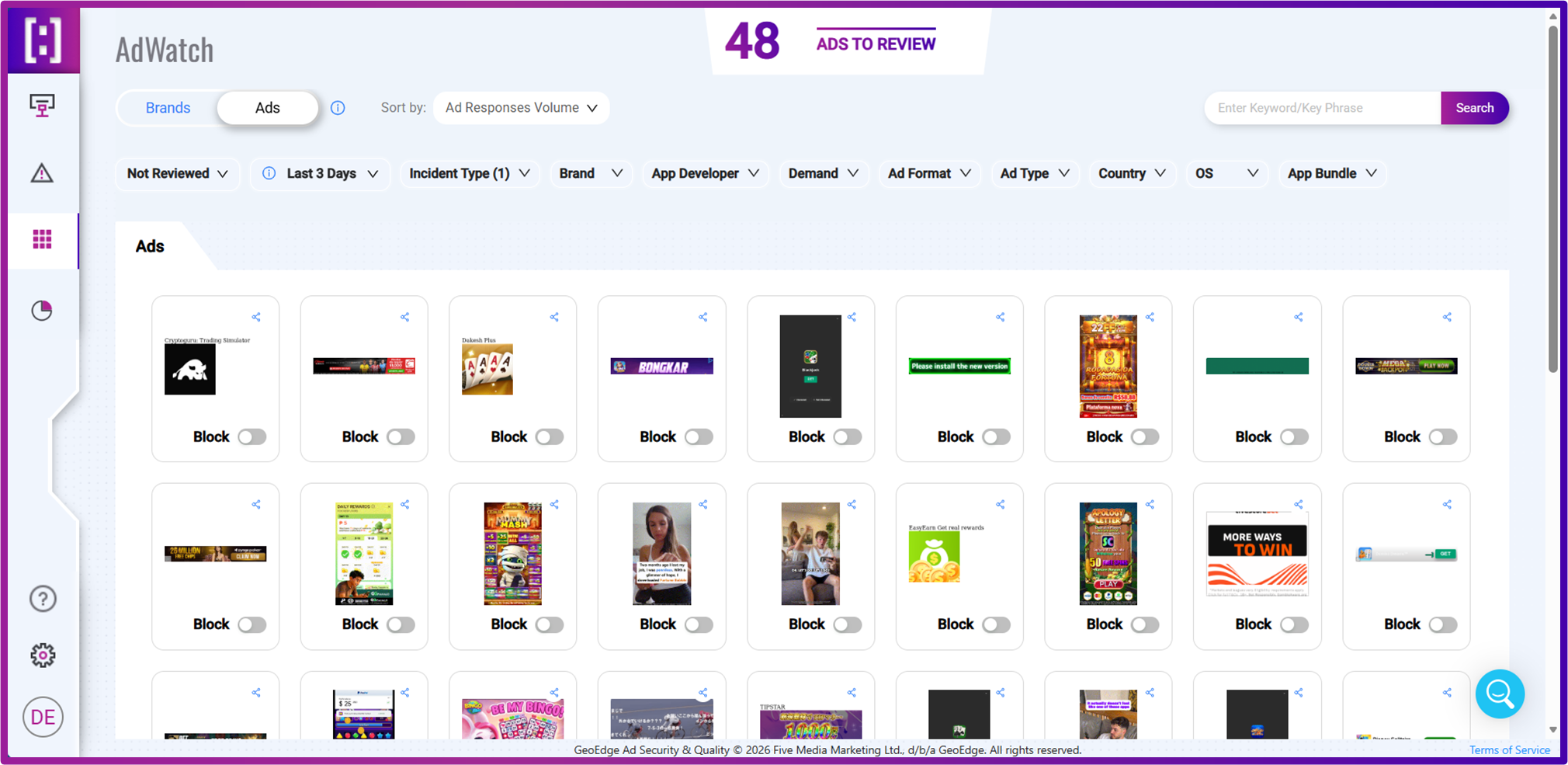
Rather than relying on advertisers’ self-declared categories, a multi-layered detection process analyzes creatives and landing pages by actual content, blocking problematic online gambling ads regardless of what category the demand partner declared. Whether they promote casino games, poker, roulette, slot machines, lotteries, social casino games, or gambling apps, ads are blocked before they reach users, across all demand sources simultaneously. The filtering is granular and publisher-controlled: block all online gambling and betting creatives entirely, allowlist specific approved sponsors, or apply geo-specific rulesets to meet regional compliance requirements, all without touching your mediation configuration.
Because enforcement happens at the SDK layer rather than the network or mediation layer, publishers are no longer dependent on demand partners to honor category exclusions consistently. Rule changes take effect immediately across all integrated demand sources, without waiting for network policy updates or mediation passthrough fixes. Impression-level reporting gives ad ops teams full visibility into what’s being blocked, flagged, or permitted, turning the filtering layer into an operational intelligence feed as much as an enforcement mechanism, and giving publishers real control over the money flowing through their ad stack.
Taking Back Control of Gambling Ads in Your App
Online gambling ad compliance isn’t a configuration problem: it’s a structural one. Standard category filters depend on accurate labeling from parties with little incentive to provide it, which is why misclassified creatives for casino games, lotteries, gambling apps, and social casino games reach inventory they were never supposed to reach, sponsorship agreements get undermined by programmatic bleed, and family gaming apps end up fielding complaints about online gambling content. The problem doesn’t resolve itself at the mediation layer.
Real-time, creative-level enforcement is what closes the gap, giving publishers granular control over which online gambling ads appear, under what conditions, and for which users. AppHarbr is built specifically for this: publisher-controlled, demand-agnostic, and operating across all demand sources simultaneously. Because by the time a misclassified casino game or lottery ad shows up in a review, the conversation has already moved from prevention to damage control, and that’s a conversation worth avoiding entirely.
Ready to take control of which online gambling ads appear in your app? Contact us for a demo or learn more about AppHarbr’s real-time ad filtering SDK.